

CARE FOR…
Together we make a difference
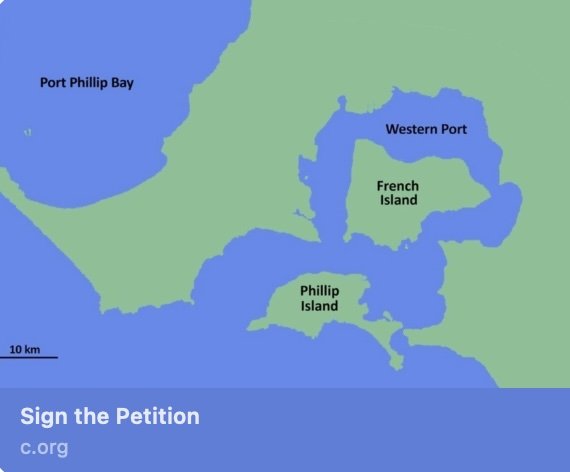
A community helping save Phillip Island
& Western Port from inappropriate development!
CARE MORE
As a signatory to the Ramsar Agreement signed in 1971, Australia is obligated to protect the Western Port Bay Ramsar site. Australia has also signed an agreement to protect 30% of oceans worldwide - currently only 3% are protected.
The Victorian Renewable Energy Terminal (VRET) proposal opens Western Port Bay to more industrialization and has the potential to harm the wetland ecosystems, migratory birds and shorebirds, whales, sea beds and other marine life. We are awaiting a decision from the Federal Minister for the Environment.
Your Voice and support is appreciated.
Save Western Port:
Protect Its Environment and Biodiversity from Urban Sprawl
For further background, please read …
UPDATES…
1. Unlocking the rural tourism strategy “BURT”
As of November 2025 this strategy has now been rescinded . A community meeting of farmers and conservationists on September 2024 overwhelmingly oppose large scale developments on land and coast on Phillip Island and called for a tourism plan that protects the islands farmland, coast and natural environment.
The Victorian Planning Minister however, cites BURT as "effectively identifying all of Phillip Island as being suitable for tourism uses".
Please continue to place pressure on council to protect our natural biodiversity as a tourist attraction ahead of short term ‘development’ income.
2. State Minister overturns VCAT permit ruling.
Victorian Planning Minister hon. Sonya Kilkenny intervened to approve the Vietnam Veteran Museum proposal on the site viewable from Churchill Island and deemed to have an inappropriate impact on the riparian Ramsar Site of Western Port Bay.
The Honorable Sonya Kilkenny is now in a position of power whereby as planning minister of Victoria, she can intervene and approve or disapprove of any proposed developments in Victoria.
Letter stating objections (PDF)
3. VCAT denied a permit for Caravan Park at Forrest Caves. They found it would be at odds with Phillip islands " wild back to nature experience "
4. Kitty Miller Bay development denied a permit from council based on the impact on landscape, environment, wildlife and the character of the quiet rural area.
STATE PARK - NOT A THEME PARK
Arthur’s Seat is well known for its wildlife and spectacular views of port Phillip Bay, extending to Melbourne, the You Yangs and Mount Macedon. The park is also home to many native species; echidnas, kangaroos, koalas, lace monitors, southern emu, wren, wedge tail eagles and native flora.
Despite this, the Hon. Minister for Planning, Sonya Kilkenny has approved a LUGE RIDE TRACK to run down the summit of Arthur’s Seat.'
Nature is our most precious asset. Please join us in voicing concerns by writing to:planning.support@transport.vic.gov.au
THE IMPORTANCE OF NATURE
Extract from “Wilding” Isabella Tree
“Nature provides a service we cannot afford to ignore. Evidence shows that people are healthier, physically fitter and better adjusted and children’s behaviour and schoolwork improve, if they have access to the countryside, parks or gardens. According to Public Health England, poor air quality in urban areas is said to be a factor in 29000 premature deaths in the UK every year.
A recent report in the “lancet “ ( the Lancet -- a world leading general medical journal) associates the noise and air pollution of busy roads with “Alzheimer’s Disease.” Fresh air long considered a tonic is not just avoiding pollution. Toxicologists are discovering that air provided by nature is loaded with microbes produced by plants, fungi and bacteria that are beneficial to health and boost the immune system. Even the remote sight of nature has curative effects. Health services have found that hospital patients need fewer painkillers after surgery and recover much faster if they have views of nature from their beds. In 2007 Natural England and the RSPB compiled studies from the UK, US and Europe in a report called “Natural Thinking” highlighting the effects of nature on mental health. One in six of the UK population suffers from depression, anxiety, stress, phobias, suicidal impulses, obsessive compulsive disorders or panic attacks – sometimes in deadly combination. This costs the National Health Service 12.5 billion pounds, the economy 23.1 billion pounds in lost output and 41.8 billion pound in the human costs of reduced quality of life and loss of life. The studies show that symptoms of all these disorders are alleviated with time spent in nature. Measurements of blood pressure, pulse rates and cortisol levels of young adults demonstrate a decrease in anger and an increase of positive mood when walking in a nature reserve, while the reverse is true when walking in an urban environment. Low levels of self-discipline, impulsive behaviour, aggression, hyperactivity and inattention in young people all improve through contact with nature. Studies on children who were bullied, punished, relocated or suffering from family strife all showed that they benefited from closeness to nature, both in levels of stress and self-worth. “